
Thoughts From the Edge

Doesn’t everybody wonder why they are here?
It is a daunting question because there is no final answer. Not one that satisfies everybody. Not one that lasts. Religion enters the empty space with answers about faith, suffering, purpose, reward, and redemption. Buddhists understand something essential about existence: life contains suffering, and suffering cannot be escaped by pretending it does not exist. Christians offer the promise of redemption and eternal life. Other traditions offer their own maps through pain, fear, guilt, desire, and death.
I could go through all the religions, but most of them share one human promise: something better may be waiting. Maybe not here. Maybe not now. Maybe not in this body. But somewhere, somehow, the search has meaning.
No matter where you live or who you pray to, human beings seem to expect a reward. We search for a path. We search for a purpose. We search for the future that will justify the present.
If we are not doing that, then what are we? Born-again nihilists? Psychotic? Or simply tired?
The need to create the future may be the one thing every human has in common. We are doomed to create. We create careers, marriages, children, art, governments, religions, theories, enemies, and explanations. We create promotions. We create agents. We create weddings. Every decision is made in the moment, but the moment is never enough. The moment always points forward. We presume we know the next step, and then the next, and then the next.
In some of its practices, Buddhism tries to step away from the karma of creation. Every action creates a ripple in the wave of life. Every choice extends beyond itself. Every intention becomes a seed. To live is to disturb the water.
A bird is required to create a nest by its patterning. A human is patterned to create a future. The future is the human version of a nest.
This may be where sanity and madness begin to touch.
People often debate whether a person who suffers from mental illness is actually ill. And if they are ill, why can’t they simply be healed? I am not sure either question is as simple as people want it to be. What seems clear is that severe mental suffering does not remove a person from the human search for meaning. It may intensify it. It may distort it. It may turn the search inward until the mind becomes trapped inside its own symbols.
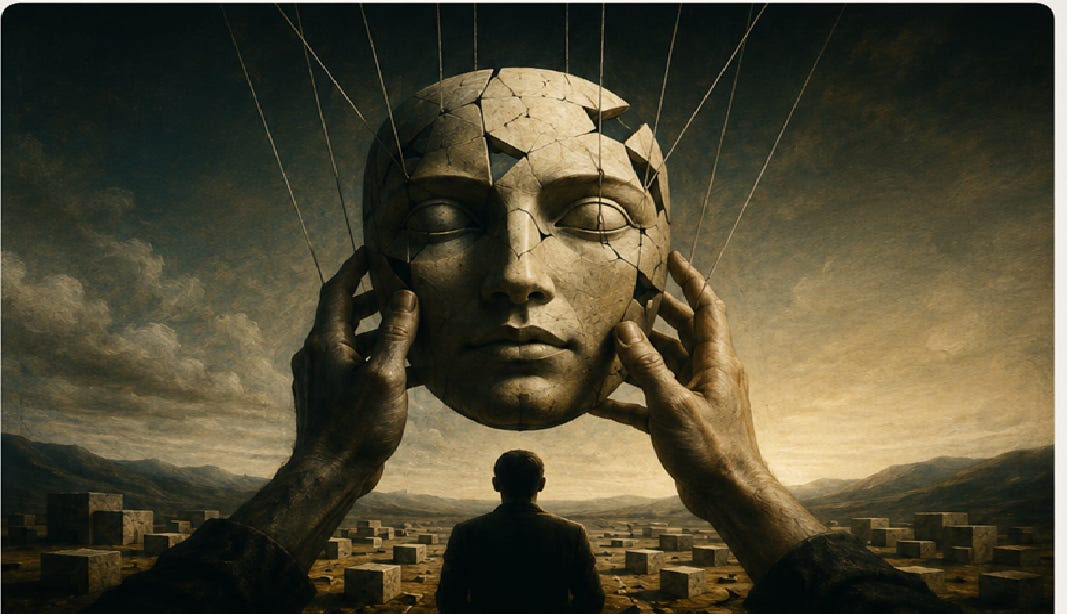
The person who believes there are wires in their body is still searching. They are searching for the source of their pain. They are searching for the system that controls them. They are searching for the reason they cannot leave the apartment, cannot enter the world, cannot do what others expect them to do.
The rest of us are also searching for invisible wires.
We search for the rules that govern our lives. We search for the reason we are anxious, poor, lonely, ambitious, jealous, bored, or afraid. We search for the mechanism. We search for the hidden system. We search for whatever is pulling on us from behind the wall.
Are we so sane that we are entirely different?
One person believes they are diseased and cannot enter the world. Another person believes that if they do not enter the world, they will be destroyed by poverty. One person cannot obey the rules of productivity because their private reality has overtaken them. The other obeys the rules of productivity because the public reality has overtaken them.
One person is trapped by a madness almost no one else can see. The other is trapped by a madness everyone has agreed to call normal.
Both are creating. One creates a world out of terror. The other creates a life inside a system they cannot control.
The material is different. The outcome is different. But the process is familiar. The mind searches. The mind builds. The mind follows clues. The mind cannot tolerate emptiness, so it creates a pattern.
We are doomed to search. It is how our minds work.
Do you doubt that? Look at movies.
Can you think of a movie that does not involve a search? Crime movies search for revenge, justice, or the killer. Romance searches for the soul mate, then creates an obstacle to delay the discovery. The obstacle is overcome, the search is rewarded, and everyone lives happily ever after. Science fiction searches for new worlds, new species, new gods, new dangers, new versions of ourselves.
Look at Star Trek, that great sixties dream: “to boldly go where no man has gone before.” Searching the universe for new life and new civilizations. But why? What else would humans do?
The same is true of television. Reality shows are searches disguised as competitions. Naked on an island? Search for food, shelter, alliance, survival. Looking for aliens? Search the sky for proof that we are not alone. The news performs the search for us and then tells us what we need to know. Wheel of Fortune turns the search into entertainment: contestants search for missing letters, missing words, missing phrases. The pleasure is not only in the answer. The pleasure is in the search.
Our being and our thought become one command: search, and then search again.
We have no choice. We are programmed to follow a trail of clues. And when there is no trail, we make one up.
Look at The Curse of Oak Island. For years, they have followed data that supposedly indicates a great treasure. But if you look closely, much of the data may only show remnants of human activity that could mean almost anything. A piece of wood. A tunnel. A coin. A fragment. A theory. Another theory. Another hole in the ground.
Yes, I watch the show.
But I think I am fascinated less by the treasure than by the search itself. The treasure almost does not matter anymore. The search has become the treasure. The need to continue has become the point.
That may be the human condition in miniature.
We are not unified by what we believe. We are unified by the fact that we search. We create so that we can search, and we search so that our creations have meaning. We build questions and then spend our lives trying to answer them.
What is the main function of computing? Databases. Why do we build databases? So we can search. We collect information, organize it, store it, retrieve it, and ask it to explain the world back to us.
And now we have AI.
AI is the search impulse turned into machinery. It searches the internet for answers. It searches patterns faster than we can. It searches language, images, code, markets, medicine, war, employment, and desire. We created a machine to search for us because human searching was too slow.
But the machine does not only search for answers. It may also search for efficiencies. It may search for redundancies. It may search for the places where human beings are no longer required.
Maybe that is what we were always building toward.
A bird creates a nest.
A human creates a future.
But maybe the future was never the real point. Maybe the real point was the problem.
Human beings seem programmed to solve. We solve for hunger, shelter, danger, illness, loneliness, status, meaning, and death. The mind wants a problem because a problem gives it direction. A problem gives the search a shape. Without a problem, the mind does not rest. It begins to invent one.
That may be our brilliance and our curse.
When there is no tiger at the edge of the firelight, we imagine one. When there is no immediate threat, we create systems, enemies, tests, ambitions, prophecies, conspiracies, and futures to fear. We are problem-solving creatures who cannot tolerate the absence of a problem.
Religion may be the greatest example. It gives us the impossible problem: Why are we here? What is suffering for? What happens after death? What does God want? How do we become worthy? These questions cannot be solved in the ordinary sense, and that may be why they endure. Religion gives the search an eternal object. It gives the mind a problem large enough to survive every answer.
Madness may do something similar, but without the shared language of faith. The person with wires in their body has also been given an impossible problem: Who put them there? What do they mean? How can they be removed? The private terror becomes a system. The system becomes a search. The search becomes a life.
And the rest of us are not as different as we pretend.
We create careers, wars, economies, technologies, religions, stories, and machines because we are trying to solve what may never be solved. Then, when our machines solve too much, we create new problems for them to solve. AI may be the latest expression of this hunger. We built a machine to search faster than us, to answer faster than us, to solve faster than us. But in doing so, we may have created a new problem we cannot solve.
That is the human pattern.
We search for the answer.
We create the problem.
Then we suffer inside the world our searching has made.
A bird creates a nest because it must.
A human creates a future because it must.
And when the future asks why we were here, maybe the answer will be simple:
We were here to solve problems.
And when we run out of problems, we create images of ourselves. Even more dangerous than the maker.